
Why does Grid hardly benefit from the curtailment of bitcoin mining?
为何比特币挖矿在常规情况下无法使电网得到裨益

(Chinese version in this article too)
There have been many arguments that the flexible load from bitcoin mining can play a role similar to that of an energy storage battery for Grid, charging when the load is low and discharging when the load is at peak. This paper will focus on several aspects to show that bitcoin mining under regular conditions cannot be used as a storage facility by Grid, and that curtailment during peak periods does not effectively solve Grid problems.
Grid
As we know, the main sources of power generation include thermal, hydro, nuclear, wind and solar power. Among them, most renewable energy power plant is not 100% uptime at work, while industrial production and consumer electricity need certainty. In addition, the electricity consumption side fluctuates at different time periods of the day and in different seasons of the year (e.g., afternoon and evening are the peaks while the late night is the trough of the day; extreme heat in summer and extreme cold in winter are the peaks).
During peak hours, Grid directs facilities with the capacity to increase the load to operate at full, and commands flexible generation units (usually thermal) to boost supply on the generation side; on the other hand, consuming units in the curtailment program begin to reduce/cease power use.
Above, flexible units (units that generate electricity during peak hours) either sell their electricity at a higher unit price or are highly subsidized by Grid and other units to maintain break-even because their total annual generation/sales are much lower than those of daily generation units; units that enter the curtailment program receive monthly or quarterly subsidies from Grid to reward them for not competing at peaks.
If there is a large amount of renewable energy (e.g., wind, light, and hydro) used for electricity generation on the Grid, its instability will increase the demand for Grid’s flexible generation loads. In 2022, China's Yunnan provincial power regulator introduced measures to require all new clean energy generation projects in its jurisdiction to bear an additional portion of the construction costs of flexible generating units (http://39.130.181.2/u/cms/ynfgw/202212/151526130a26.pdf), suggesting that the era of obtaining subsidies for clean energy construction is fading away. When a relatively advanced Chinese power Grid has made such a move, we tend to believe that more countries and regions will take the same action in the future.
The principle and prospect of peak power replenishment of energy storage power plant
Energy storage plants can definitely help with calming down the load fluctuation of the Grid, charging at valley load while discharging at the peak, not to mention increasing proportion of electricity generated by clean energy. Ideally, if there is an unlimited load of energy storage facilities, the clean energy power generation ratio can achieve close to 100%.
The earth's fossil energy and coal reserves are very large, but because of the mining economics, the price of energy may be super volatile, which is one of the main drivers to boost the development of clean energy sources. Likewise, energy storage facilities with unlimited loads are difficult to make it happen due to economics.
At present, the main energy storage power plant technologies are lithium ion and sodium ion. The huge demand for lithium batteries at the consumer end raised the cost of construction materials; the latter is relatively cheap, but it takes huge land area. From an economic point of view, promoting sodium-ion energy storage on a large scale in the future is more promising.
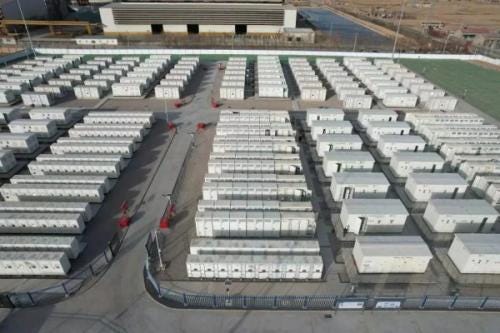
(An old version power storage station in western China)
In addition to power storage power stations, there are power storage reservoirs that can play the same role. But the Grid response time of power storage reservoirs is too long compared to energy storage power stations (usually a few milliseconds).
In short, the best strategy to deal with the greater demand for electricity is to upgrade Grid transmission. Gradually convert all thermal power generation to flexible generating units, and then accelerate the construction of clean energy power generation and storage facilities.
Bitcoin mining increased the demand for electricity
Miners who aspire to be clean bitcoin producers will describe the impact of mining practices on Grid as an energy storage battery, as both invest in hardware facilities and calculate payback cycles. Although bitcoin miners participate in curtailment, the profitability strategy will not allow miners to use electricity only in the valley load, so they are still competing for power with residents and industry. At the same time, mines do not have the discharge function as an energy storage station during peak load but simply sell the electricity at a high price (either allowance from ERCOT or price spread by PPA).
More importantly, clean energy infrastructure construction in the US will be booming under the Inflation Reduction Act. The adaptation and upgrade of power generation facilities and Grid will lead to a tighter balance of electricity consumption-supply (expanding clean energy generation into Grid needs to be configured with 1) an upgraded Grid; 2) more flexible power generation facilities; and 3) energy storage facilities. All of the above require huge costs and preparation). According to the Cambridge Bitcoin Power Consumption Index (https://ccaf.io/cbeci/index), the total global load for bitcoin mining is around 14GW. Assuming that US miners account for 30% of the total network computing power (the actual figure might be higher, https://ccaf.io/cbeci/mining_map), the total load is already close to 1% of the entire US electricity load. It should be noted that the electricity consumed by the oil and coal mining across the whole US takes less than 2% of the total load (https://www.eia.gov/consumption/manufacturing/data/2018/pdf/Table1_1.pdf).
U.S. infrastructure setup is extremely expensive, while the actual construction can be elongated by a variety of factors. More investment in Grid and energy storage facilities help bitcoin miners mine while allowing them to sell electricity to Grid for subsidies via curtailment doesn't seem very politically correct. (This paper only predicts the impact of the growth of bitcoin mining on the power system; there is no data to support the significant change in Grid load before and after the introduction of bitcoin mining.)
At this point, the author wishes to point out that the massive rollout of bitcoin mining (and mining farms) we can see now is the result of some specific conditions. For example, the redundancy of public resources brought by the massive infrastructure upgrades in China after 2008 allowed bitcoin miners to grow rapidly from 2013-2020; while in the US during the same period, under tight balance (infrastructure is more about economics and have less redundancy), public resources can only be taken up in small loads and distributedly. After 2021, a large number of bitcoin mining computing power landed in the United States, I believe that mining in the United States in the long term is still profitable, but need to get "ready to pay"for the price of occupying public resources (including taxes, assistance in the construction of power Grid or storage facilities, more power outages back to compensate, etc.). All in all, the profitable bitcoin mining model may be coming to an end, and the rising implicit cost will bring the net profit margin of bitcoin mining on par with other (gold, copper) mining models.
*This article discusses bitcoin mining in a conventional scenario. The above analysis does not apply to off-Grid mining by energy companies or to low-cost mining with flexible power usage.
中文版本:
一直以来,有很多论点认为比特币挖矿所得有的可调节负荷,能够对电网起到类似于储能电池的作用,全网负荷较低时充电,而当全网负荷过高时放电。本文主要将从几个方面来说明,常规状况下的比特币挖矿,不能被电网系统当做储电设施使用,并且高峰期回补电并不能有效解决电网问题。
第一,电网
我们知道,发电的来源主要包括火力,水力,核能,风能和太阳能等。其中,绝大部分可再生能源是不能100%在线率工作的,但生产和生活中的用电需要确定性。除了确定性,用电端在一天不同时段和一年的不同季节均有波动性(例如,一天中的下午和傍晚是用电高峰而深夜是用电低谷;夏季极热和冬季极冷时是用电高峰)
在用电高峰时段,电网会指导具备提高负荷能力的设施尽量满负荷运转,并且调度灵活发电机组(通常是火力发电)提升发电端的供给;另一方面,进入curtailment计划的用电单元开始减少/停止电力使用。
以上,灵活发电机组(高峰时间发电的单元)因其年总发电/售电量远远低于日常发电单元,所以要么以较高单价出售电力,要么电网和其他单元给与其高额补贴以维持盈亏平衡;进入curtailment计划的用电单元,则会按月度或季度获取电网的补贴,奖励他的不争抢电力行为。
若电网中有大量的清洁能源(例如风,光和水力)发电,其不稳定性会增加电网对灵活发电机组负荷的需求。在2022年,中国的云南省电力监管部门曾经出台措施,对于辖区内所有新建清洁能源发电项目,要求其额外负担部分灵活发电机组的建设费用(http://39.130.181.2/u/cms/ynfgw/202212/151526130a26.pdf)。这是一个非常重要的信号。以往新能源建设获取补贴的时代渐渐远去,相对先进的中国电网做出这样的动作,不得不让我们联想未来会有更多国家和地区会采取同样的行动。
第二,储能电站的高峰期回补电力原理及展望
用电低谷充电,用电高峰放电,大型储能站一定可以帮助平抑电网负荷波动,更不必说新能源发电占比越来越高的情况下。最理想的,若是有无限负荷的储能设施,理论上新能源发电占比能实现接近100%。
地球上的石化能源和煤炭储量(已探明和未探明的)非常大,但因为开采不经济,确实面临越用越少的风险,这也是发展新能源的动力之一。同样,无限负荷的储能设施,也很难实现单体的经济效益,需要逐步建设以及研发更高效的技术。
目前主要储能电站技术包括两种,一种是锂离子,另一种是钠离子。前者因电池消费品端的巨大需求,建设原料成本抬升;后者相对便宜,唯一被诟病的是建设占地面积大。从经济角度看,大规模推广钠离子储能的前景是广阔的。
除储能电站外,还有储能水库能起到相同的作用,差别是储能水库的电网反应时间过长,效果不比储能电站(通常是几毫秒)。
综合来说,应对更大的用电需求,最佳策略即是:升级电网传输,所有火力发电逐步转为灵活发电机组,全力扩大新能源发电和储能设施建设。
第三,比特币挖矿,主要影响仍在于扩大了用电需求
志在成为清洁比特币生产者的矿工,会把挖矿行为对电网的影响类比成储能电池的作用,因为同样都是对硬件设施进行投资和计算回报周期。 虽然比特币矿工会参与curtailment,盈利策略不会允许矿工只使用用电低谷的电,所以仍然是在与居民和工业生产抢电。同时,矿场在用电高峰并不具备储能站的放电功能,而仅仅通过暂停用电将用电量高价卖出。
更重要的是,通胀缩减法案下美国境内的新能源基建会越来越多,发电设施和电网的适配升级会导致当下的用电紧平衡(增加的新能源入网需配置1)升级的电网;2)更多的灵活发电设施;3)储能设施。以上都需要巨大的成本和准备时间)。根据剑桥比特币耗电指数(https://ccaf.io/cbeci/index),全球比特币挖矿的总负荷在14GW左右。假设美国矿工占全网算力30%(实际数据也许更高,https://ccaf.io/cbeci/mining_map),总负荷也已经接近全美用电负荷的1%。需要指出的是,全美石油和煤炭开采所耗费的电力,也不会占总负荷的2% (https://www.eia.gov/consumption/manufacturing/data/2018/pdf/Table1_1.pdf)
美国基建的成本极其昂贵,同时建设周期也会因为各种因素拉长。更多的电网和储能设施投资的一部分帮助比特币矿工挖矿,同时允许他们通过curtailment卖电给电网获取补贴,这似乎不太符合政治正确。(本文只预测比特币挖矿的增长对电力系统的影响,未有数据佐证引入比特币挖矿前后电网负荷的显著变化)。
讲到这里笔者希望指出,比特币挖矿(以及矿场)的大规模铺设,是在特定时间和特定背景下的结果。例如,2008年后中国大规模的基建升级带来的公共资源冗余使得比特币矿工得以在2013-2020大发展;而同期在美国,在紧平衡下(基建更讲究经济性,不太会有冗余)公共资源的占用只能小负荷,分布式的推进。 2021年之后,大批比特币挖矿算力登陆美国,笔者认为在美国挖矿长期看仍然是有利可图,但需要做好“ready to pay”的准备,支付占用公共资源的对价(包括税,援助建设电网或储电设施,更多断电回补等)。总而言之,暴利的比特币挖矿模式也许要告一段落,隐形成本的抬升将使比特币挖矿的净利润率向其他(金矿,铜矿)挖矿模式看齐。
*本文讨论的是常规情形下的比特币挖矿。若是能源公司off-grid自营挖矿业务亦或是灵活使用电力的低成本挖矿,不适合以上分析。